
English| EUR
Suggested for you
More currencies
Choose a language
Every winter, travellers arrive in South Iceland with a rental car, a headlamp and a plan to find a blue ice chamber unaccompanied. Vatnajökull National Park does not work that way, and the reason is written into the ice itself. This guide sets out what independent visitors can and cannot reach, and where the line falls.
Quick answer
No — ice caves inside Vatnajökull are not accessible on your own; access requires booking a guided tour. Entry to Vatnajökull National Park itself is free at 0 ISK, so the landscape, roads and marked viewpoints stay open to independent travellers. Only the caves are restricted. Cave locations shift yearly, and a licensed operator is the sole lawful route inside.
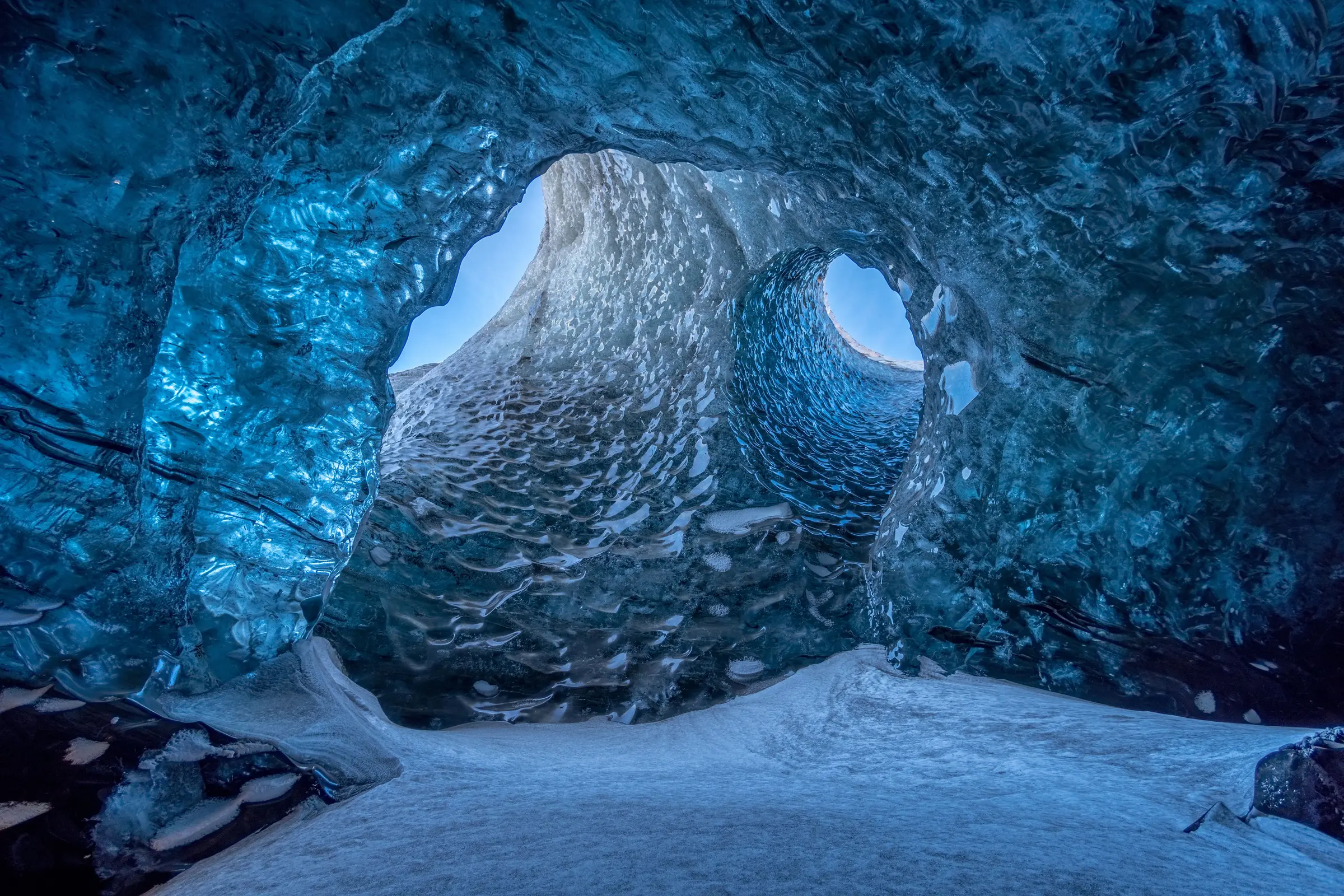
Vatnajökull covers roughly eight percent of Iceland's surface, and the caves beneath it are not permanent structures. They are drainage tunnels, carved by meltwater each summer and refrozen into blue chambers each winter, then collapsed or flooded again by spring. No two seasons produce the same cave in the same place. That single geological fact answers most of what travellers want to know before they arrive at Vatnajökull National Park, South Iceland. So, can you visit ice caves in Iceland on your own? Not inside this glacier. The park charges no entrance fee — 0 ISK — and independent visitors are free to drive the Ring Road, park at Jökulsárlón, walk the shoreline at Diamond Beach and photograph the outlet glaciers at Skaftafell and Breiðamerkurjökull without booking anything. The restriction applies specifically to the ice caves, which require a mandatory paid guided tour. That distinction confuses people, because the park gate and the glacier gate are not the same threshold. The reasoning is practical rather than bureaucratic. Glacier tongues are laced with crevasses hidden under snow bridges, and the entrances to a Vatnajökull ice cave move between seasons as the ice advances and retreats. Licensed operators survey their caves repeatedly through the season, monitor meltwater levels and roof thickness, and hold the super-jeep access to the tracks that reach them. They also carry the crampons, helmets and harnesses that make the approach viable. An unguided Vatnajökull glacier hike onto that terrain is not a shortcut; it is the reason Icelandic search-and-rescue teams stay busy each winter. What this means in planning terms is simple. Treat the glacier as a booked appointment rather than a stop you drive to. Build the rest of the day around the free-access sights — the lagoon, the black sand, the Vatnajökull National Park visitor centres — and let the cave itself be the fixed point in the schedule. Anyone still asking can you visit ice caves in Iceland on your own will find the same answer from the park authority, from the operators and from the ice: the caves open only with a guide beside you. Official park information is published at vatnajokulsthjodgardur.is, and the dedicated sections below cover access steps, timing, costs and what to bring.
“The park gate and the glacier gate are not the same threshold — one is free and open, the other opens only with a guide beside you.”
This procedure covers the correct route into a Vatnajökull ice cave: confirming that independent entry is not permitted, then arranging legal guided access. Planning and booking take about 30 minutes; the meeting-point transfer and cave visit itself run several hours on the day.
Ice caves inside Vatnajökull National Park cannot be entered on your own — access requires booking a guided tour. The common mistake is assuming free park entry (0 ISK) also means free-roaming glacier access; it does not.
Ice caves sit inside a moving glacier that shifts, refreezes and collapses without warning, and crevasses are frequently hidden under snow bridges. People misjudge this because a cave mouth looks solid from the road, when stability is assessed daily by guides who monitor that specific cave.
Check https://www.vatnajokulsthjodgardur.is and Icelandic road and weather services before travelling. Travellers often rely on social media photos or old blog posts, which show caves that have since melted, moved or been closed.
Reserve a place with a certified glacier operator, who supplies helmets, crampons and the required safety briefing. The frequent error is leaving booking until arrival — cave capacity is limited and walk-up entry is not an option.
Travel to the operator's meeting point rather than driving toward the cave itself, then transfer in their vehicle. Many visitors attempt the final approach in a rental car and find the F-road or glacier track legally and mechanically off-limits.
Follow the roped or flagged route your guide sets and remain in the group inside the cave. Stepping aside for a clearer photo is the single most common cause of falls into meltwater channels and crevasses.
Do not break off ice, enter side chambers, or continue if your guide calls the visit off. Turnarounds happen when meltwater rises or the ceiling shows fresh fracturing, and arguing the point costs the whole group its window.
The primary season for visiting ice caves in Vatnajökull National Park occurs from November through March. During this period, lower temperatures stabilize the glacier ice, allowing for safer access to cave formations.
Cold, 0°C to -10°C
This is the peak operational window when ice structures are most stable.
Variable, 2°C to 10°C
Most caves are inaccessible or deemed unsafe due to seasonal melting and water accumulation.
Determined by guide
Arrival times are set by guided tour schedules, as independent access is prohibited at all times.
Verdict: The best window for ice cave visits is mid-winter, specifically January and February, when cold conditions maximize ice stability.
Entrance to Vatnajökull National Park is free of charge. However, entering ice caves requires a mandatory guided tour, which carries its own service cost.
Verdict: While park admission is 0 ISK, you must pay for a professional guided tour to access ice caves safely.
Because ice caves on Vatnajökull can only be entered with a licensed guide, preparation centres on securing that booking and arriving with the right gear and fitness.
Everything you need to know about can you visit ice caves in iceland on your own
No, it is not possible to visit the ice caves at Vatnajökull independently. Safety regulations and the dynamic nature of the glacier necessitate professional supervision for all visitors. You must book a guided tour to enter these environments.
Attempting a self-guided trip to the ice caves is prohibited and dangerous. Glacial landscapes change daily, and only certified mountain guides possess the equipment and local knowledge to navigate shifting crevasses and unstable ice. Access is strictly managed to ensure participant safety.
Yes, you must be accompanied by a certified glacier guide to explore the caves. Professional tours provide essential safety gear, such as helmets and crampons, while navigating the hazardous terrain of the glacier. These guides are trained to identify structural risks in the ice.
Even in winter, when the caves are most stable, the rules remain the same. Whether you want to see a blue ice grotto or a crystalline cavern, the standard requirement is to join an organized excursion. There are no provisions for independent access to these restricted zones.
Attempting to access these natural features without authorized supervision puts your life at risk and violates park regulations. Visitors who ignore these rules face severe safety hazards, including falls into hidden crevasses or being trapped by flooding. Always prioritize professional oversight for your glacier trek.
You can arrange a visit by booking through authorized tour operators that partner with the national park. Since can you visit ice caves in Iceland on your own is not a viable option, these guided experiences are the only way to reach the glacier safely. Please view our booking options to find an authorized provider.
There are no exceptions to the rule prohibiting independent access to the ice caves. The glacier is a volatile, high-risk environment that requires specialized technical skills and local monitoring. For your safety, always book a guided experience.
Vatnajökull Blue Ice Cave Tour
Read more Tickets & toursVatnajökull Crystal Ice Cave Tour
Read more Tickets & toursIce Cave Tours from Jökulsárlón
Read more GuideCan you visit ice caves in Iceland in summer?
Read more Tickets & toursVatnajökull Ice Cave Tours from Reykjavik
Read more Tickets & toursVatnajökull Ice Cave Tour with Glacier Hike
Read more